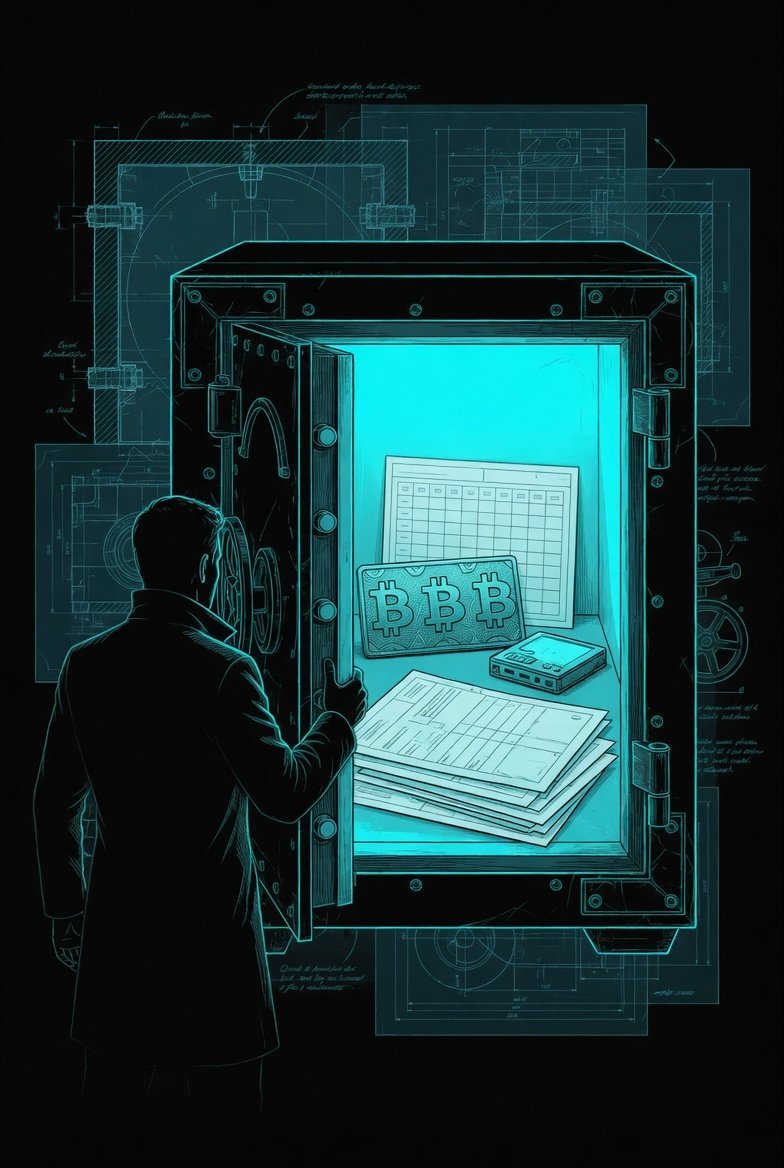
Cold Storage: Building Your Own Digital Vault in a Basement, 1980s Style
Air-gapped security. No connectivity. No theft.
In 1985, the latchkey kid’s dad didn’t trust banks. He kept cash in a safe in the basement. Not para‐
noia — just good sense. Money in a bank could be seized or frozen. Money in a safe in the basement
was his.
This is cold storage applied to Bitcoin.
Cold storage means: Bitcoin stored on a device that is completely disconnected from the internet. No
WiFi. No cellular. No ethernet. Completely air-gapped.
An exchange like Coinbase? Connected to the internet. If Coinbase gets hacked, your Bitcoin is ex‐
posed.
A hardware wallet kept in a safe with no internet connection? Impossible to hack remotely. The only
way to steal it is to physically break into the safe.
Cold storage is the highest level of Bitcoin security.
Here’s how to set it up:
Option 1: Hardware Wallet
Buy a hardware wallet — Ledger, Trezor, or similar. These are small devices that generate private keys
and never expose them online. You connect the wallet to a computer only when you want to send Bit‐
coin. You sign the transaction on the device itself. The private key never leaves the hardware.
Then you disconnect the hardware and store it in a safe. Physical security becomes your only vulner‐
ability.
Cost: $50–300. Security: Military-grade.
Option 2: Paper Wallet
Generate a private key on a completely air-gapped computer (one that’s never been connected to the
internet). Write the key down on paper. Store the paper in a safe. Never connect that computer to the
internet.
Cost: Essentially free. Security: Excellent if done correctly.
Option 3: Metal Backup
Write your seed phrase (the 12 or 24 words that back up your Bitcoin) on a metal plate. Metal doesn’t
degrade. Paper burns. Fire is the enemy of paper. Metal survives fire.
Store the metal plate in a safe deposit box or a home safe.
Cost: $100–500. Security: Fireproof.
Why this matters:
Every day, exchanges get hacked. Not because they’re incompetent. Because they’re online. And
anything online is a target.
Between 2011 and 2022, billions of dollars in Bitcoin were stolen from exchanges. Billions. The largest
exchanges have been hacked. The most sophisticated security teams have been breached.
If your Bitcoin is on an exchange, you’re betting that the exchange’s security is better than every
hacker’s skill. That’s a bad bet.
If your Bitcoin is in cold storage, the only person who can take it is someone who physically breaks
into your safe and guesses your password (if you use a password-protected wallet).
The latchkey kid in the basement with a safe understood this instinctively. Physical security is the most
reliable security. A lock and a key and a vault that nobody else has access to.
Bitcoin’s equivalent is cold storage.
The tradeoff:
Cold storage is secure but inconvenient. If you want to spend your Bitcoin, you have to take it out of
cold storage, connect it, send it, and put it back in cold storage. That’s a process.
For money you’re planning to spend regularly, you might keep some on an exchange or a mobile wal‐
let (connected to the internet). For money you’re saving long-term, cold storage is the only option that
makes sense.
The military calls this “belt and suspenders.” You have redundancy. Some Bitcoin in cold storage (your
savings). Some Bitcoin in a hot wallet (your checking account equivalent). Money you’re actively
trading on an exchange (your speculative account).
Different levels of security for different purposes.
Building your own vault:
Here’s a basic setup:
- Buy a safe. Fireproof. Waterproof. At least $500. This is non-negotiable. A cheap safe is not a safe.
- Generate cold storage. Use a hardware wallet or generate a paper wallet on an air-gapped compute
- Backup your seed phrase. Write it on metal or engrave it into metal. Store multiple copies in different locations (your home safe, a safety deposit box at a bank, maybe a friend’s safe).
- Write down instructions. If something happens to you, your heirs need to know how to access your Bitcoin. Write down the process, store it separately from the seed phrase.
- Test your recovery. Recover from your backup at least once to make sure it actually works. Don’t discover on your deathbed that you’ve been backing up the wrong thing.
This is not complex. This is not expensive. This is just basic security — the kind people have been
doing with physical valuables for centuries.
Bitcoin is just the digital equivalent.