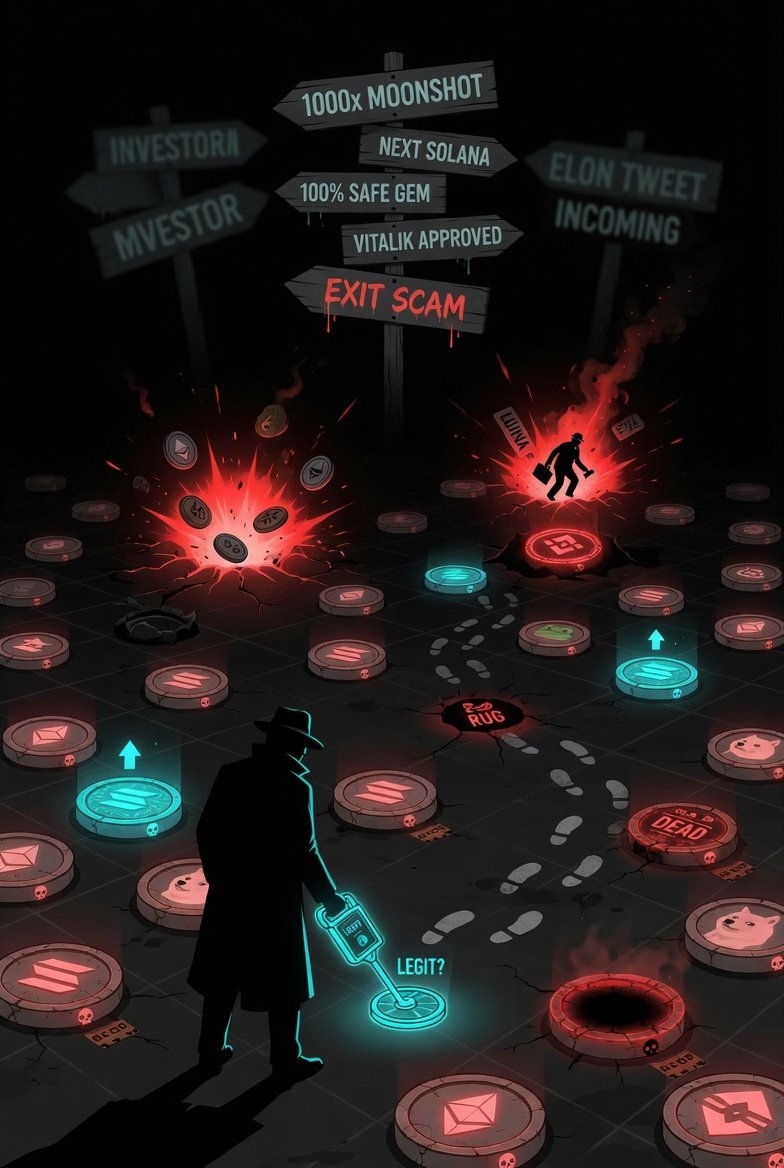
The Altcoin Minefield: How to Spot the Scams Before They Spot You
90% are trash. 9% are hopes. 1% might matter.
A new cryptocurrency launches. The website looks professional. The marketing is slick. The community
is enthusiastic. The roadmap is ambitious.
Six months later, the founder disappears. The price collapses ninety percent. You realize you’ve been
scammed.
This happens. Constantly. It’s the nature of altcoins (any cryptocurrency that isn’t Bitcoin).
There are over 10,000 cryptocurrencies. Maybe five have real utility. The other 9,995 are either out‐
right frauds, misguided projects, or vehicles for the founders to extract wealth from retail investors.
The anatomy of an altcoin scam:
- White paper: A document explaining the project’s technology. Sounds impressive. Uses technical language that’s designed to confuse rather than clarify.
- Community: Hype. Discord channels. Twitter accounts. Influencers pumping the coin. They’re all being paid (usually in the coin they’re promoting).
- Pre-mine: Founders “reward” themselves coins before the public launch. They get rich if the price goes up.
- Development: Nothing real. Maybe a GitHub repository with code copied from other projects. Maybe nothing at all.
- Promise: “We’ll revolutionize [insert industry]. We’ll be worth trillions.”
- Launch: Price shoots up on hype. Early investors get rich (on paper). This attracts new investors.
- Dump: Founders and early investors sell their pre-mined coins. Price collapses. New investors are left holding worthless tokens.
This is called a “pump and dump.” It’s illegal in traditional markets. In crypto, there’s barely any
regulation, so it happens constantly.
How to avoid it:
1. Does it have a real use case?
Bitcoin’s use case is clear: store value without a bank. Ethereum’s use case is clear: smart contracts.
Ethereum isn’t Bitcoin, but it’s not useless.
Most altcoins don’t have a real use case. They’re “the next Bitcoin” or “Bitcoin but faster” or “Bitcoin
but with more features.” These don’t have a use case. They’re just coins.
Ask: what real problem does this solve that Bitcoin can’t? If you can’t answer clearly, it’s probably a
scam
2. Is there code?
Real projects have open-source code. You can review it. You can verify that it does what they claim.
If the code is a black box, or doesn’t exist, it’s a scam.
3. Who are the founders?
Are they real people? Can you find them on LinkedIn? Have they built other successful projects?
If the founders are anonymous, be skeptical. Not all anonymous projects are scams (Bitcoin was
created anonymously), but most altcoin scams hide behind anonymity.
4. Is the project decentralized?
If a single person or company controls the coin, it’s not a cryptocurrency — it’s a private token. Ripple
(XRP) is a great example. It’s not decentralized. Ripple Labs controls it.
Don’t confuse tokenized stocks with cryptocurrencies.
5. Are there huge pre-mine or founder allocations?
If the founders allocated themselves fifty percent of the coins, that’s a red flag. They’re designed to
get rich if the price goes up. They don’t care about you.
Compare to Bitcoin: Satoshi mined coins in the early days when they were worthless. He never cashed
out. The allocation is relatively fair.
6. Is the marketing excessive?
Real projects get adoption through utility. People use them because they’re useful.
Scams get adoption through marketing. Influencers. Celebrity endorsements. “Get in on the ground
floor.” It’s pressure, not education.
If you hear more about the marketing than the technology, it’s probably a scam.
7. Is the community cult-like?
Healthy projects have healthy skepticism. People question the roadmap. People point out problems.
Scams have cultish communities. You question the project, you get banned. You point out flaws, you’re
a “FUD spreader.” The community is designed to suppress critical thinking.
The investment thesis:
Bitcoin is designed so that nobody needs to trust the system. The math works. The security is proven.
Most altcoins require you to trust the founders. Trust that they’ll execute. Trust that they won’t
abandon the project. Trust that they won’t dump their pre-mine at the worst time.
That trust is usually misplaced.
The latchkey lesson:
The latchkey kid learned early: people will scam you if given the opportunity. He didn’t trust promises.
He verified.
Apply the same logic to altcoins. Don’t trust promises. Verify the code. Verify the founders. Verify the
use case.
If you can’t verify something, don’t buy it.