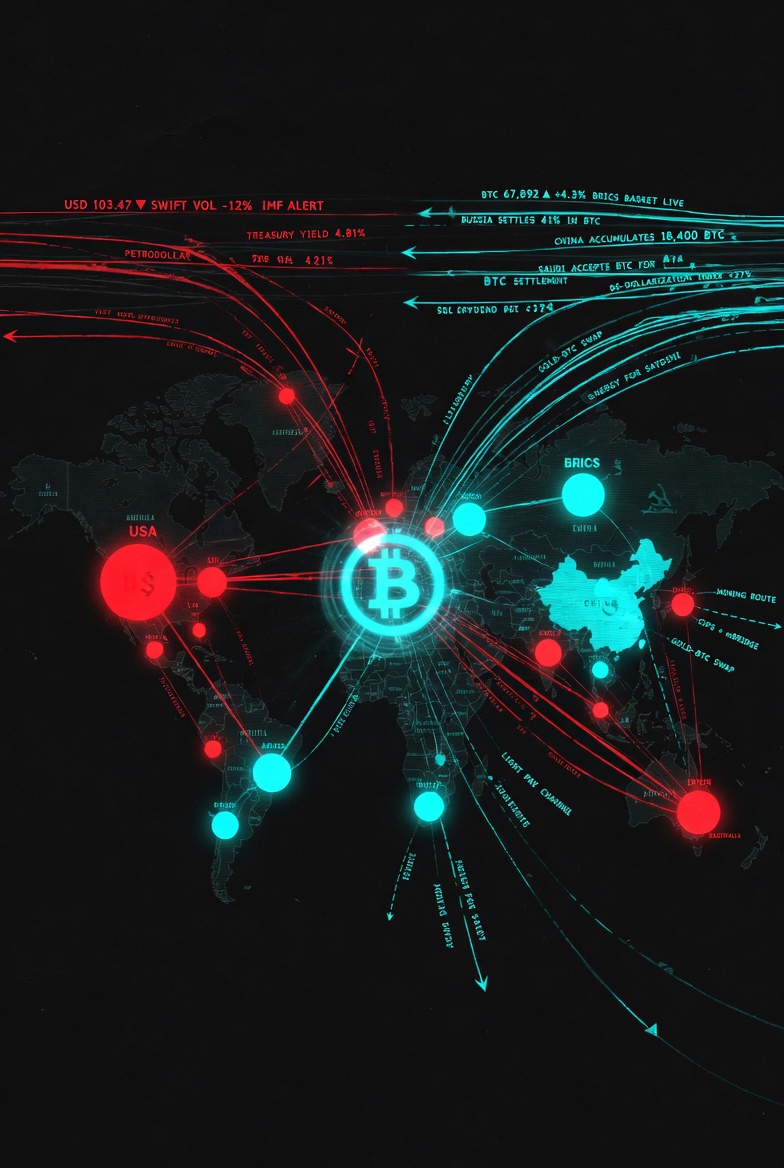
The Global Stage: How Nation-States Are Waking Up to the Noir Reality
Governments understand. That’s why they’re afraid.
El Salvador became the first nation-state to adopt Bitcoin as legal tender. The president declared
Bitcoin was freedom. He was also using it to escape the dollar system.
Turkey and Russia are accumulating Bitcoin. China is building a massive mining infrastructure.
None of these countries are motivated by idealism. They’re motivated by survival.
Why nation-states care about Bitcoin:
Dollar hegemony is ending.
The US dollar has been the world’s reserve currency since Bretton Woods (1944). This gave the US
extraordinary power.
If you want to do international trade, you use dollars. That means you need US banks. That means the
US can sanction you. That means the US can freeze your assets.
This power has made the US wealthy. It’s also made the US arrogant. The US has been throwing
sanctions around at anyone who disagrees with them.
Russia. Iran. Venezuela. Cuba. North Korea. China (selectively). Turkey (selectively).
Every sanction pushes countries away from the dollar system. Every time the US freezes a nation’s
assets, other nations ask: “Could this happen to us?”
Bitcoin is the answer. Bitcoin can’t be frozen. Bitcoin can’t be sanctioned. Bitcoin exists outside the
dollar system.
The de-dollarization movement:
Countries are actively moving away from dollar-based trade. China is pushing the yuan for internation‐
al trade. Russia is using rubles and local currencies. The BRICS countries (Brazil, Russia, India, China,
South Africa) are developing alternatives to the dollar.
Bitcoin is part of this. Not the whole solution, but a piece.
A country can accumulate Bitcoin reserves the way they accumulate gold. If the dollar collapses or
loses reserve status, Bitcoin becomes a fallback asset.
China’s perspective:
China doesn’t allow citizens to own Bitcoin. China bans crypto exchanges.
But China is mining Bitcoin. China is accumulating Bitcoin.
This isn’t contradictory. China understands that Bitcoin is a future currency. They want control over the
supply (mining). They don’t want their citizens to escape the Chinese currency system.
This is the authoritarian playbook: ban it for citizens, accumulate it for the government.
Russia’s perspective:
Russia is actively using Bitcoin to escape sanctions. The US can freeze Russian dollar assets. But
Russia can’t hold dollars. So they’re holding Bitcoin.
The US has been pressuring other countries not to trade with Russia. Russia is turning to Bitcoin and
crypto to bypass the payment system.
This proves Bitcoin’s utility. It’s not speculative. It’s practical.
The global bifurcation:
The world is splitting into two systems:
System 1: Digital dollars (CBDCs)
Centralized, programmable, traceable, reversible. Controlled by the Federal Reserve and allied governments. Used by wealthy Western nations that benefit from the dollar’s hegemony.
System 2: Bitcoin (and alternative cryptos)
Decentralized, uncensorable, immutable. Controlled by nobody. Used by governments avoiding
sanctions, businesses avoiding restrictions, people escaping monetary collapse.
Both will coexist. But the balance is shifting.
As more countries accumulate Bitcoin and develop crypto infrastructure, Bitcoin becomes less
replaceable. The network effects increase. The security strengthens.
The latchkey angle:
The latchkey generation understands that power structures fail. The institutions that seem permanent
collapse. The systems that seem unchangeable change.
The dollar system seemed permanent. It lasted eighty years. But it’s ending.
Bitcoin is the system built for a world where permanent institutions don’t exist. It doesn’t rely on trust
in governments. It relies on math.
That’s why governments are afraid of it. They understand that Bitcoin represents the end of their
monetary control.
The opportunity:
For individuals, this global bifurcation is an opportunity.
If you hold dollars, you’re betting on the continued dominance of the Western system.
If you hold Bitcoin, you’re hedging that bet. You’re saying: I don’t know which system wins, but I want
exposure to the alternative.
Most people only understand one system. They see the dollar as inevitable. They don’t see the
possibility that it could lose reserve status.
Bitcoin holders are planning for that possibility.