Fiat Decay: How the 1971 Break Changed Everything for Our
Generation
The day the gold ran out. The theft began.
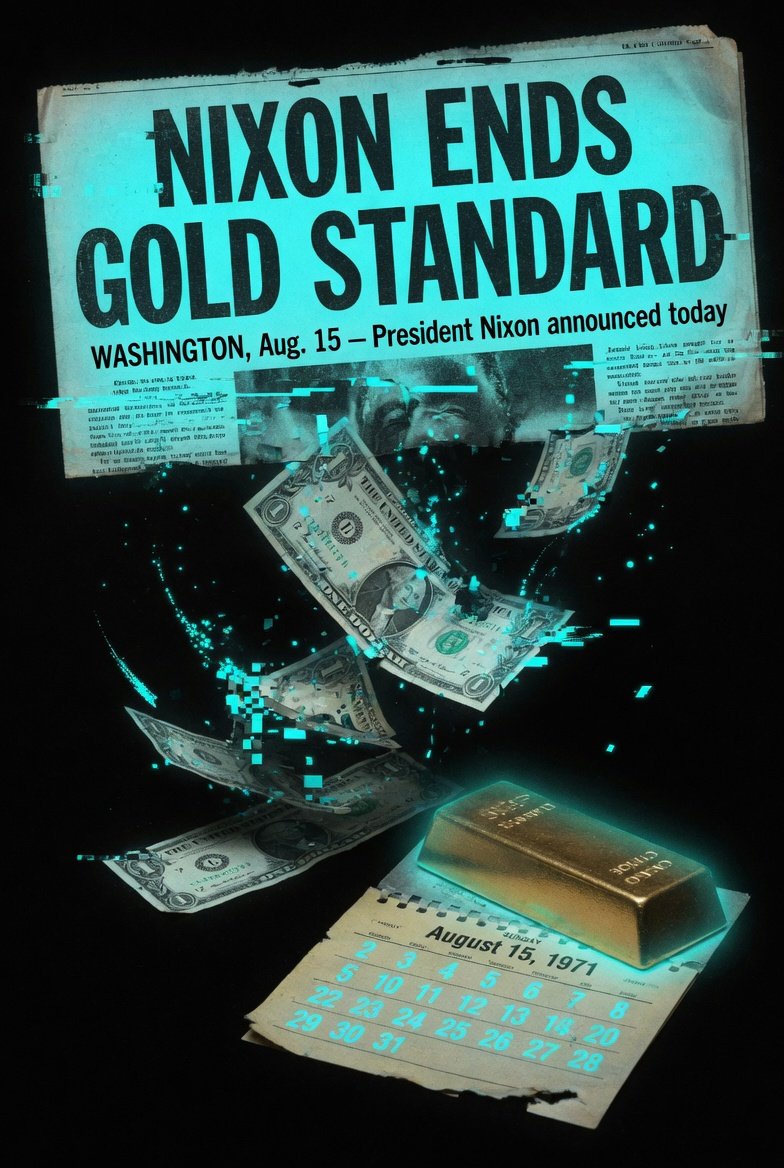
August 15, 1971. President Nixon announced that the U.S. would no longer redeem dollars for gold.
The deal — made after World War II — was over. You could no longer walk into a bank with a dollar bill
and say: “Give me the gold this represents.”
The dollar became “fiat.” Faith-based. Backed by nothing but the government’s word that it would
always be worth something.
That was the day the trap was set for our generation.
In 1971, a gallon of milk cost thirty-five cents. A new car cost around thirty-five hundred dollars.
College tuition was a few hundred bucks per semester. A house in Ohio was forty thousand.
Today, a gallon of milk costs four dollars. A car costs thirty-five thousand. College is thirty thousand
per year. That same house is two hundred and fifty thousand.
The numbers didn’t change because things got better. They changed because the dollar got worse.
Your grandfather’s purchasing power in 1971 = 100 cents.
Your purchasing power in that same 1971 dollar today = about 8 cents.
That’s not inflation. Inflation is a word they use to hide the theft.
It’s currency debasement. It’s theft with a Fed chairman’s signature.
Here’s how it works: The government wants to spend money on something. But raising taxes is unpop‐
ular. So instead, they have the Federal Reserve print new money. The supply of dollars increases. Your
slice of the total money supply gets smaller. Your dollar is worth less. Your purchasing power evapor‐
ates.
But because the process is slow and disguised under the word “inflation,” most people never see it
coming. They just notice that everything costs more, their salary never keeps up, and the retirement
they saved for buys half of what they expected.
That’s the scheme. And it started in earnest in 1971.
Before 1971, the government had a discipline. They could only print as many dollars as they had gold
to back. The gold reserve was the anchor. It prevented runaway printing.
In 1971, they cut the anchor loose.
The latchkey kid’s dad worked the same job for forty years. By the end of his career, his paycheck
bought maybe thirty percent of what it bought at the start. He worked longer. Earned more nominally.
But the currency he was paid in was being debased continuously.
He wasn’t getting poorer. The money was getting poorer. The government was stealing from him while
he slept.
And it accelerated. The bigger the spending problem, the more they printed. The more they printed,
the faster the decay. By the 1980s, inflation was in double digits. Interest rates hit twenty percent.
Savings were suicide.
The message came across clear: there’s no such thing as saving anymore. The currency would always
decay faster than you could accumulate it.
So people stopped saving and started borrowing. Got mortgages. Got car loans. Got credit cards. Took
on debt because in a decaying currency, debt is an asset.
That shift — from saving to borrowing — destabilized everything. It made people dependent on credit.
Made them vulnerable to interest rates. Made them prisoners of the debt cycle.
August 15, 1971 was the day the system became extractive by design.
Bitcoin goes the other way. Fixed supply. No printing. No debasement. No theft dressed up as
“monetary policy.” Honest accounting.
That’s not ideology. That’s arithmetic.