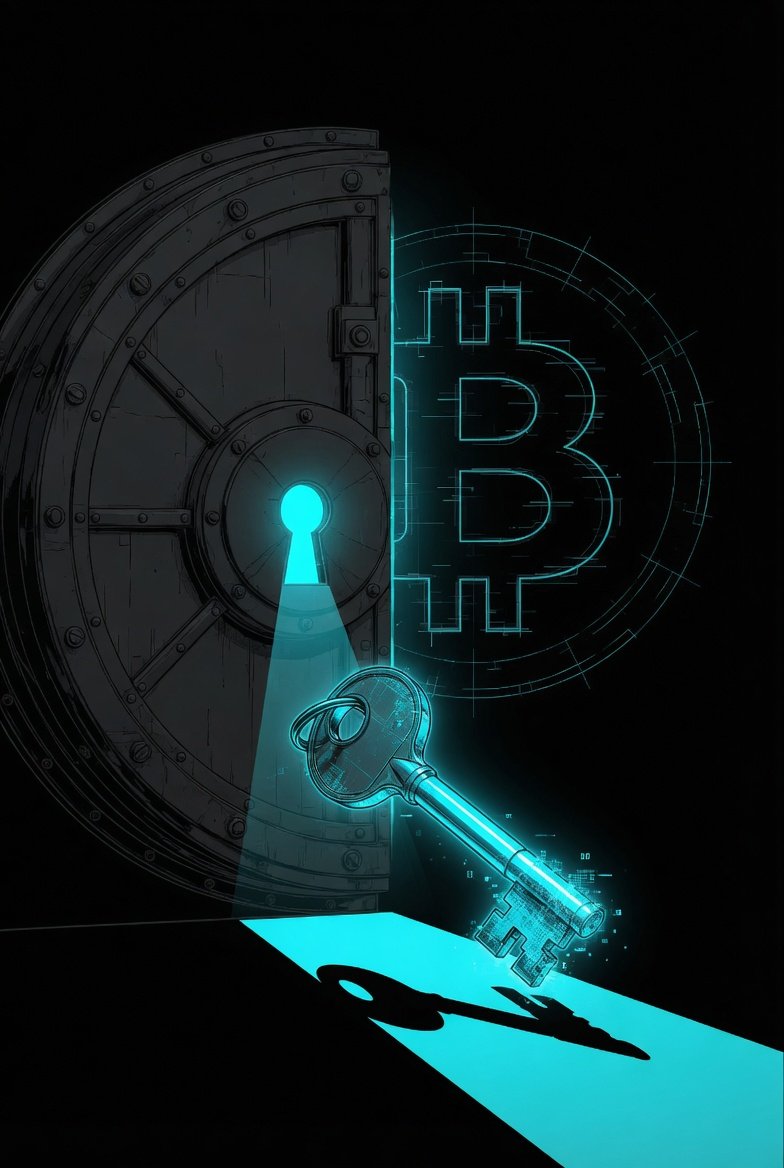
Sovereign Custody: If You Don’t Own the Keys, You Don’t Own the Door
Possession is everything.
You buy Bitcoin on an exchange — Coinbase, Kraken, FTX back when it existed.
You see a number on the screen. “You own 0.5 Bitcoin.” You feel ownership.
You don’t.
You own a claim to Bitcoin held by someone else. If the exchange gets hacked, your Bitcoin gets
stolen. If the exchange goes bankrupt, it gets liquidated. If the government seizes the exchange, it
gets frozen. If the platform decides you violated their terms, it gets locked.
That’s not ownership. That’s a receipt.
Actual ownership means you hold the private key. The key is a long string of numbers and letters that
you and only you know. It’s like the key to a vault except the vault is protected by cryptography that
would take millions of computers millions of years to crack.
Your private key opens the vault. It moves the Bitcoin. It proves you own it.
If you don’t have the key, someone else does. And if someone else has the key, they own the Bitcoin.
Not you.
The difference is absolute. Not semantic. Not philosophical. Absolute.
A latchkey kid at nine years old understands possession differently than a kid with parents who man‐
age everything. The latchkey kid comes home. The door is locked. He has the key. He opens it. He
owns the access. Nobody can deny it. Nobody can revoke it.
That’s sovereign custody
How to achieve it:
You buy Bitcoin (on an exchange, if you need to). Then you move it to a “wallet” you control — hard‐
ware wallet, paper wallet, or cold storage. The moment the Bitcoin leaves the exchange and arrives at
an address where only you hold the private key, you own it.
Now the exchange can get hacked. Doesn’t matter. Your Bitcoin is still yours.
The government can seize Coinbase. Doesn’t matter. Your Bitcoin is still yours.
Bitcoin can crash eighty percent. Doesn’t matter. Your Bitcoin is still yours
That’s the difference between ownership and custody.
The phrase “not your keys, not your coins” isn’t a slogan. It’s law. It’s how the system is architected.
It’s non-negotiable.
For a generation that grew up learning that institutions fail — pensions disappear, banks collapse,
promises evaporate — this is revolutionary.
You don’t need to trust the bank to hold your money. You hold it. You don’t need to trust the govern‐
ment to let you keep it. You keep it. You don’t need to ask permission to move it. You move it.
The private key is the string around the neck. The Bitcoin is the house. You own both.
The tradeoff is responsibility.
Lose the key, lose the Bitcoin forever. No customer service. No “contact us” button. No recovery. The
architecture is immutable because immutability is the point.
Your grandfather’s generation trusted institutions because institutions were relatively stable. Banks
didn’t fail. Pensions paid out. The system held.
Your generation knows better. You watched pensions vanish. You watched banks get bailed out while
people got nothing. You learned early: institutions lie.
Bitcoin acknowledges that truth and builds around it. You don’t trust an institution. You trust the math.
You hold the key.
That’s not paranoia. That’s pattern recognition.
The VA lost your dad’s file three times. You couldn’t trust them. So you kept your own copy. You held
the keys to your own records. Bitcoin operates on the same principle.
You hold the keys. You own the Bitcoin. Nobody can take it. Nobody can freeze it. Nobody can seize it.
That’s sovereignty. That’s why it matters.