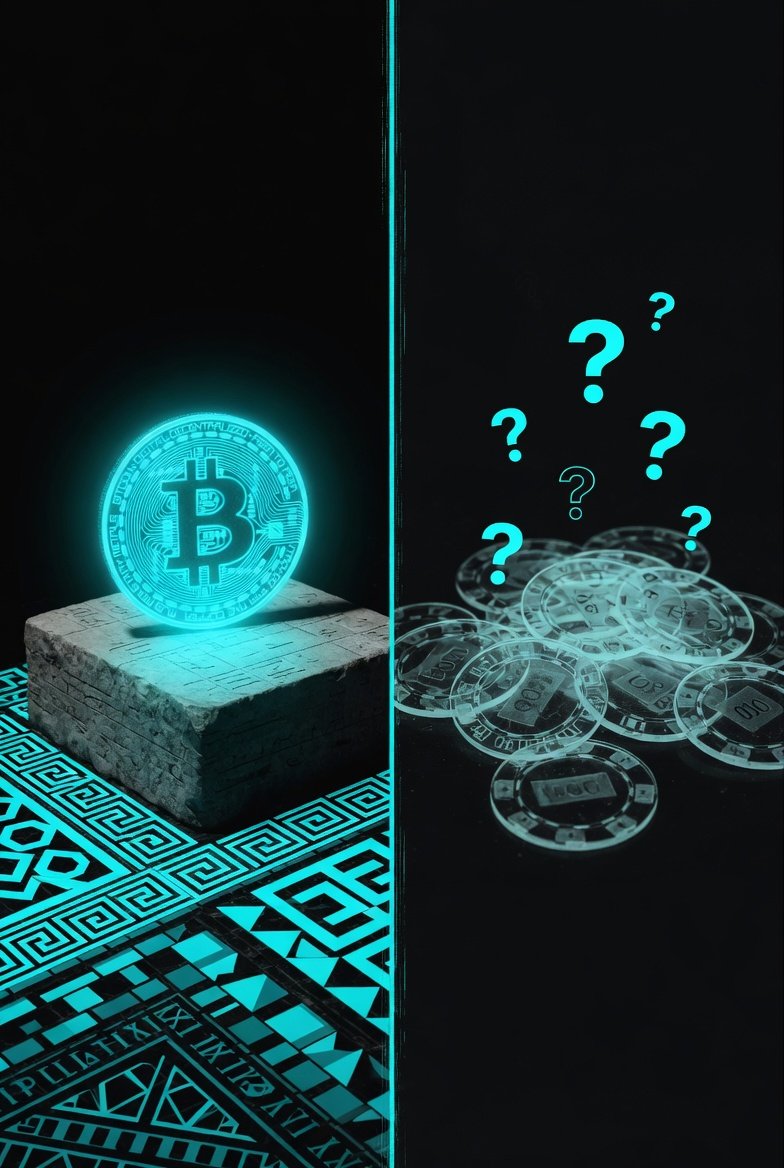
Hard Money vs. Easy Pills: Why Bitcoin Isn’t “Crypto
One is money. The rest are chips in a casino.
The word “crypto” is marketing speak. It lumps together Bitcoin, Ethereum, dog coins, and whatever
token some influencer pumped last week and calls them all the same thing.
They’re not the same thing.
Bitcoin is money. Digital, but money. It has properties of money: scarcity, durability, divisibility, portab‐
ility, recognizability. It can be stored. It can be transferred. Its supply is fixed. Its rules are unchange‐
able
Everything else is speculation. Mostly trash.
Here’s the distinction that matters:
Bitcoin is hard money. The supply is capped at 21 million coins. Period. No more can be created. No
committee can vote to increase it. No developer can change the rules without fracturing the network.
The difficulty of mining increases as more miners compete, so creating new Bitcoin takes more energy
and more computation over time. The system gets harder, not easier. Inflation approaches zero.
Everything else is easy money. Ethereum can be created at scale by its developers. Dogecoin was
literally a joke that became “money” because it was traded. Ripple (XRP) is controlled by a company.
Stablecoins are just fiat with an extra step — they’re supposed to be pegged to the dollar, which
means they inherit the dollar’s decay.
Easy money follows the same pattern as fiat. Somebody controls the spigot. They can print more if
they need to. They can change the rules if it benefits them. The supply is theoretically unlimited.
That’s not money. That’s a token. That’s a chip you can trade at a casino.
The latchkey kid learned the difference between money and promises early. A five-dollar bill in his
pocket was five dollars. He could spend it anywhere. Nobody could revoke it. It had value because the
world accepted it.
A promise from an adult that “things will get better” was worth less than paper. Promises get broken.
Money doesn’t.
Bitcoin is money. It has been spent by millions of people. It has a market price. It moves across bor‐
ders without permission. It can’t be counterfeit. It can’t be revoked. You don’t hold it based on
someone’s promise
Everything else is a promise wrapped in marketing language.
When people say “crypto is scam” or “crypto is a pump,” they’re usually right. They’re talking about
ninety-nine percent of the tokens out there — projects with no actual innovation, projects that exist to
enrich the developers, projects that pump on hype and crash on reality.
Bitcoin is different because it doesn’t need the hype. It works without anyone’s belief. The network
runs itself. The math runs itself. You can be a complete skeptic and still use Bitcoin. The system
doesn’t care.
That’s the difference between hard money and easy pills.
Easy pills are addictive. You take one, you feel rich (in theory), you want more. “This token will moon.”
“The devs have the vision.” “Trust the roadmap.” All the language of addiction and cultism.
Hard money is boring. Bitcoin doesn’t pump on promises. It doesn’t have a roadmap that changes
every quarter. It doesn’t have a charismatic founder or a roadside community manager on Discord
hyping the latest development.
Bitcoin just works. Transparently. Predictably. Without asking for your faith.
For a generation that watched institutions fail, that’s not a bug. That’s the whole appeal.
You don’t need to believe in Bitcoin. You need to understand that Bitcoin can’t lie to you the way the
Fed lies. The math is public. The supply is fixed. The rules are written in code.