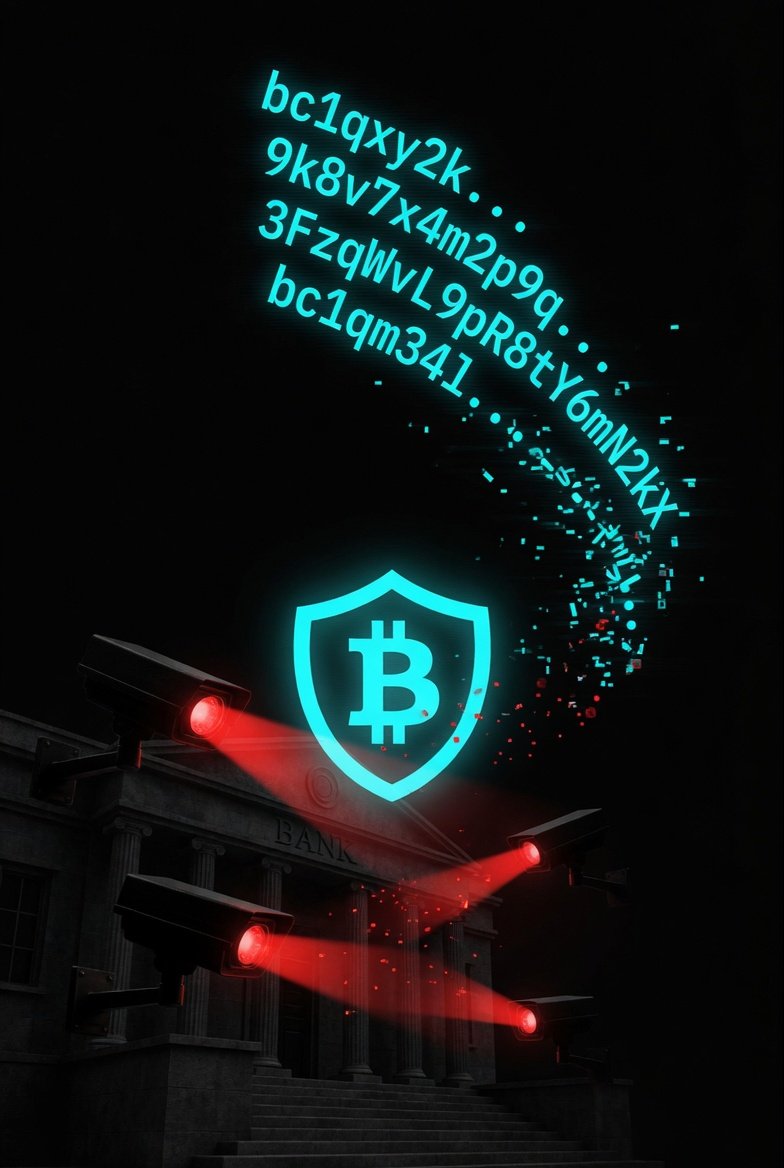
Privacy as a Shield: Why Your Data is Your Last Line of Defense
Visibility kills. Invisibility saves.
They know everything about you.
Your bank knows your balance, your spending patterns, your vendors, your locations. They flag “suspi‐
cious activity” without defining what suspicious means. Your transaction could get frozen because an
algorithm decided it looked weird.
Your employer knows your salary, your benefits, your health. They can see how much you’re earning
and adjust your position accordingly.
Your government knows your address, your vehicle registration, your voting record. They can monitor
your movements through toll cameras and cell towers.
That data is a vulnerability. It’s a leash.
Bitcoin is different because Bitcoin is pseudonymous. You don’t need to give your name to transact.
You don’t need to provide identification. You don’t need to explain where the money’s going.
You get a Bitcoin address. That address is a string of numbers and letters. It’s not linked to your iden‐
tity. You can generate new addresses for each transaction. The transactions are on a public ledger, so anyone can see the movement of Bitcoin between addresses. But they can’t see who controls each
address unless you tell them.
That’s privacy by default.
Now, privacy isn’t about hiding illegal activity. Privacy is about control. It’s about deciding what
information about you is public and what’s private.
The latchkey kid understood this. He didn’t tell his parents where he was going or what he was doing.
Not because he was doing anything wrong, but because he had autonomy over his own information.
He controlled his movements.
Bitcoin operates on the same principle. You control your transactions. You decide what gets revealed.
Here’s why this matters:
Financial data is the most powerful surveillance tool ever created.
Governments and corporations have discovered they don’t need to follow you in person. They just
need to see your transactions. Where your money is going reveals where you are, who you associate
with, what you buy, what you believe in, what you fear.
A transaction history is a complete biography. It reveals your political donations, your medical
expenses, your habits, your relationships.
If that data is visible to a centralized authority, that authority has leverage. They can use it against
you.
Bitcoin prevents that. Your transactions are private unless you choose to reveal them. You can move
value across borders without declaring it to customs. You can support a cause without government
surveillance. You can store wealth without financial institutions knowing its size or location.
Now, governments are developing surveillance tools specifically designed to track Bitcoin. Chain ana‐
lysis companies study the ledger, trying to link addresses to identities. It’s a game of hide and seek.
But the game is in your favor. You control your privacy. The government needs to surveil you. That’s
asymmetry.
Privacy is also a defense against inflation and confiscation.
If your bank account is visible to the government, the government can confiscate it. Not with violence
(not usually), but through law. They can seize it “for the greater good.”
That sounds extreme. It’s not. History is full of governments confiscating private wealth: the Nazis
seized Jewish assets. The Soviets confiscated land and savings. India confiscated large cash
denominations. Venezuela is currently destroying the currency.
For a generation that watched government bailout banks while people got nothing, privacy is a
rational response.
Bitcoin gives you the option. You can be transparent or you can be private. You choose.
Banks don’t give you that option. They surveil you by default. You can’t opt out.