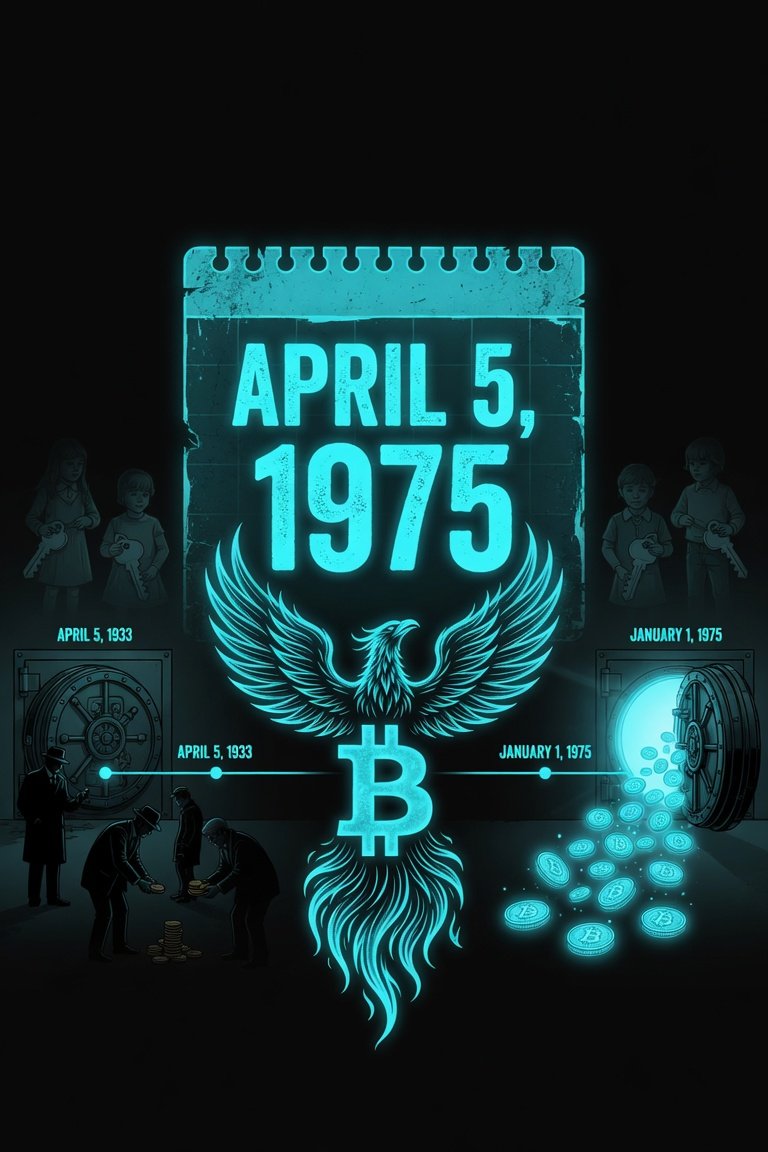
April 5, 1975: The Birthday That Explains Bitcoin
Satoshi’s “birth” wasn’t random. It was a declaration.
Satoshi Nakamoto listed a single personal detail on his P2P Foundation profile: a birthday. April 5, 1975.
Nobody knows if this was real. Nobody knows if “Satoshi” was one person, a team, or a ghost in the machine. But the date itself? That wasn’t random. That was a message.
April 5, 1933: President Franklin D. Roosevelt signed Executive Order 6102. The government confiscated gold. Every American was required to surrender their gold coins, bullion, and certificates to the Federal Reserve by May 1. If you refused, you faced a $10,000 fine (worth roughly $240,000 today) and ten years in prison.
The justification? “Hoarding.” The government needed to expand the money supply to fight the Great Depression. Gold was the constraint. So they seized it.
Citizens turned in their gold at $20.67 per ounce. The government melted it down, stored it at Fort Knox, and immediately revalued it to $35 per ounce. A 59% devaluation of the dollar. The government profited. The people got robbed.
That confiscation lasted forty-one years. Americans couldn’t legally own gold until December 31, 1974. The ban was lifted on January 1, 1975.
Satoshi’s birthday combines the date of confiscation (April 5) with the year gold ownership was restored (1975).
That’s not a coincidence. That’s a thesis statement.
The Gen X connection:
April 5, 1975, puts Satoshi squarely in Generation X. Born between 1965 and 1980, Gen X came of age during the Savings & Loan crisis, watched the dot-com bubble burst, and saw the 2008 financial collapse destroy the economy while banks got bailed out.
Gen X learned early: institutions lie. Governments confiscate. The system isn’t built for you.
Bitcoin’s design reflects that worldview perfectly.
Bitcoin is a Gen X invention.
Not because of Satoshi’s age (real or symbolic). Because of Bitcoin’s architecture.
Self-reliance: You hold your own keys. You validate your own transactions. You don’t trust a bank to protect your money. You protect it yourself.
Gen X grew up as latchkey kids. They came home to empty houses. They cooked their own meals. They figured things out without adult supervision. Bitcoin operates on the same principle: you don’t wait for permission. You take responsibility.
Skepticism of authority: Bitcoin has no central authority. No CEO. No board of directors. No government oversight. The network runs itself. The code is the law
Gen X watched Watergate. Watched Iran-Contra. Watched the Pentagon Papers. They learned that authority lies. Bitcoin removes the need to trust authority
Sound money and hard work: Bitcoin’s supply is fixed at 21 million. No politician can print more. No central bank can devalue it. The system enforces scarcity through proof of work—literal energy expenditure.
Gen X remembers when a dollar had purchasing power. They watched inflation destroy savings. They watched the government debase the currency while calling it “stimulus.” Bitcoin is the rebellion against that theft.
Peer-to-peer and anti-fragile: Bitcoin is decentralized. No single point of failure. No institution that can be pressured, corrupted, or shut down.
Gen X came of age during the end of the Cold War. They understand distributed systems are stronger than centralized hierarchies. Bitcoin is that principle applied to money.
Practical tech over hype: Bitcoin is minimalist. It does one thing well: transfer value without a trusted third party. It’s not flashy. It’s not pumping new features every quarter. It works.
Gen X values function over form. Bitcoin’s elegance is in its simplicity.
The Cypherpunk lineage:
Bitcoin didn’t appear from nowhere. It came from the cypherpunk movement—cryptographers and libertarians active in the 1990s who believed privacy was a right, not a privilege.
The cypherpunks created the technical foundations: Hashcash (proof of work), b-money (decentralized currency), Bit Gold (unforgeable digital scarcity). Satoshi synthesized these into Bitcoin.
The cypherpunk mailing list was where Bitcoin was announced. Hal Finney—a legendary cypherpunk and Gen Xer himself—received the first Bitcoin transaction from Satoshi on January 12, 2009.
This wasn’t a corporate product. This wasn’t a Silicon Valley startup. This was a group of people who watched governments spy on citizens, banks control money, and institutions centralize power—and they built the antidote.
Why the birthday matters:
Satoshi could’ve listed any date. Could’ve left the field blank. Instead, he chose April 5, 1975.
That choice says: Bitcoin is a response to government confiscation. Bitcoin is the return of monetary sovereignty. Bitcoin is what happens when a generation learns that the system is designed to extract wealth, not protect it.
Gen X didn’t create Bitcoin because they were smarter. They created it because they had no choice. The system failed them. The pensions vanished. The banks collapsed. The promises evaporated.
Bitcoin is the system you build when you stop trusting anyone to save you.
The latchkey generation grew up holding their own keys. Bitcoin gave them the key to their own money.
April 5, 1975, wasn’t a birthday. It was a declaration of independence.