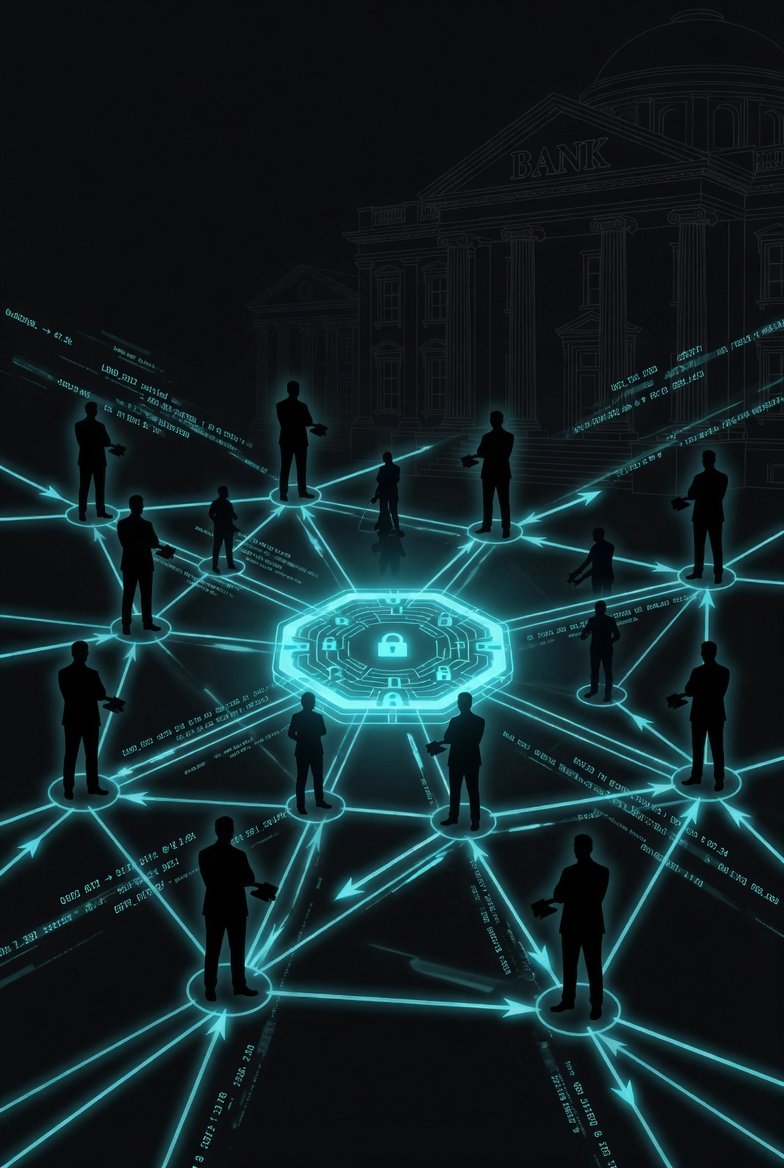
DeFi Decoded: Banking Without the Bankers
Loans, savings, investment. No permission slip required.
You want a loan. You go to a bank. The bank runs a credit check. Asks about your income. Looks at
your employment history. Maybe denies you because you don’t fit their criteria.
If they approve, you pay them interest. They invest that money and make more interest on it. You pay
them for the privilege of borrowing your own future earnings.
DeFi — Decentralized Finance — removes the bank.
Instead, you deposit Bitcoin or another cryptocurrency. A smart contract lends it to someone else.
They pay interest on the loan. That interest goes to you. No bank. No approval committee. No credit
score.
How it works:
You have 1 Bitcoin. You don’t want to sell it, but you need cash. Normally, you’d go to a bank and take
a loan against your assets.
With DeFi: You deposit your Bitcoin into a lending smart contract. The contract automatically lends it to
someone who needs the cash. They pay interest. You earn the interest. Your Bitcoin is still yours — it’s
held by the smart contract, locked.
The borrower puts up collateral (other cryptocurrency) that’s worth more than the loan. If they don’t
repay, the contract automatically liquidates their collateral and returns your Bitcoin plus interest.
This all happens without a person involved. No loan officer. No credit committee. No paperwork.
Why this matters:
Banking is rent-seeking. Banks take your money, lend it out at a higher rate, keep the difference. They
provide a service (matching savers with borrowers, managing risk). But they also take a massive cut
for that service.
DeFi cuts out the middleman. Savers and borrowers connect directly through smart contracts. The dif‐
ference in interest rates (what savers earn versus what borrowers pay) is much smaller because
there’s no bank taking the spread.
Savers earn more. Borrowers pay less. The system is more efficient.
For a generation that learned that banks are institutions that betrayed them in 2008, this is visceral.
The bank crashed the economy. Got bailed out. Then charged you fees for the privilege of keeping
your money safe. DeFi says: you don’t need them.
The risks:
DeFi is young. The smart contracts are sometimes buggy. A $600 million hack happened in 2022
because a smart contract had a vulnerability. People lost everything.
So DeFi isn’t risk-free. It’s riskier than a bank account (which is FDIC insured up to $250k).
But the interest rates are higher. You’re accepting more risk for more reward.
This is actually honest. Banks hide risk. They tell you your money is “safe” while taking massive risks
with it. When those risks blow up, they get bailed out and you get nothing.
DeFi is transparent. You see the risk. You decide if the interest rate justifies it. You’re not deceived.
The specific applications:
Lending pools: Deposit your crypto, earn interest. Variable interest rate based on supply and de‐
mand.
Staking: Lock up your crypto in a smart contract. Earn rewards. Used by Ethereum and other proof-ofstake blockchains.
Liquidity pools: Deposit pairs of crypto tokens (like Bitcoin and Ethereum). Traders swap between
them using your liquidity. You earn a percentage of the fees.
Yield farming: Combine the above to maximize returns. It’s complex, high-risk, but can generate
significant yields
Leverage trading: Borrow money to buy more crypto. Amplify gains. Also amplify losses. This is
where people get wiped out.
Why the latchkey lens:
The latchkey kid didn’t get a bank account because his parents thought he was responsible. He got
one because he needed somewhere to put his money.
The bank didn’t earn trust — it earned deposits. The kid knew the difference.
DeFi operates on the same principle. The smart contract doesn’t need trust. It enforces the agreement
through code. You deposit money because the system is trustless, not because you trust anyone.
The bank demands you trust them. DeFi demands you trust the math.
The future of banking:
Banks will either adapt or die. Some are building DeFi interfaces. Some are acquiring DeFi platforms.
They understand that decentralized finance is inevitable.
But for a generation that learned banks can’t be trusted, DeFi is the future of finance.
It’s not perfect. It’s risky. But it’s honest.