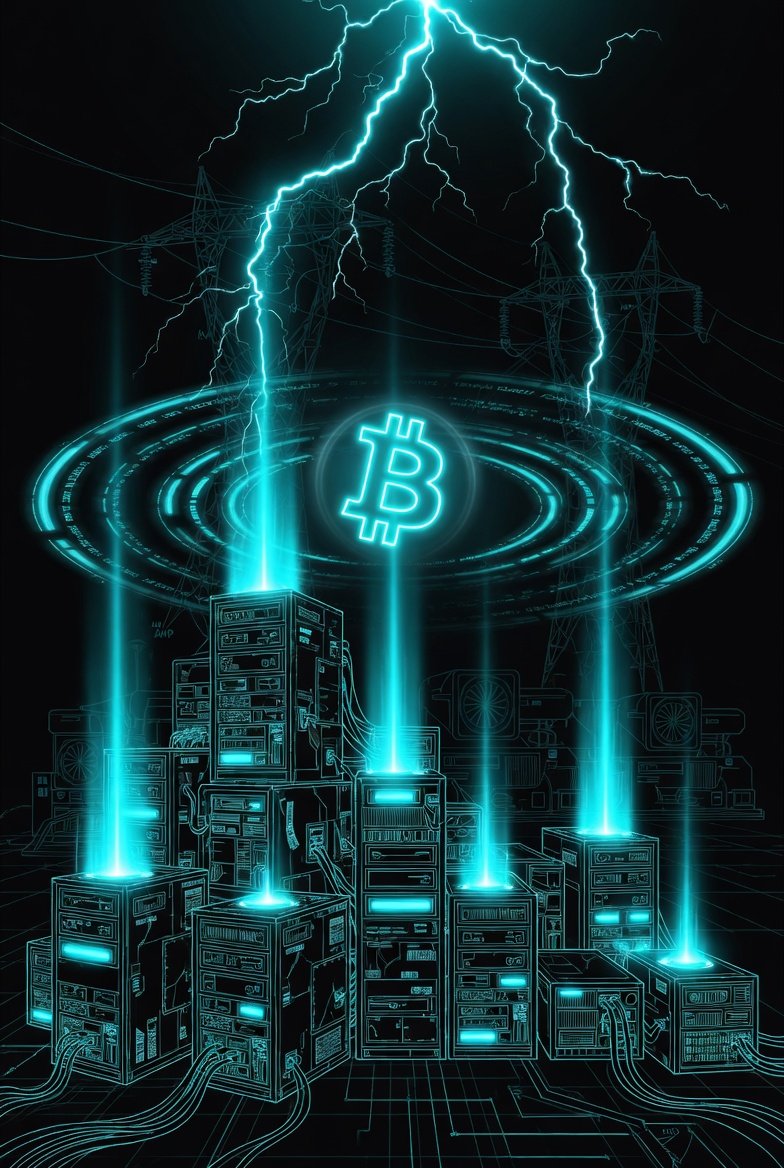
Mining for Truth: Where Bitcoin’s Value Actually Comes From
Value is mined, not printed.
“Bitcoin has no intrinsic value.”
You’ve heard this from economists, financial advisors, your uncle at Thanksgiving who watches CNBC.
They’re technically right and completely wrong at the same time.
Bitcoin has no intrinsic value in the way gold does — you can’t eat it, build a bridge with it, or turn it
into a microchip. But you also can’t eat a dollar bill. A dollar bill has no intrinsic value either.
The question isn’t whether Bitcoin has intrinsic value. The question is: where does anything get value?
Value comes from scarcity and usefulness. Bitcoin has both.
Scarcity: 21 million coins. No more. Ever.
Usefulness: You can send value across borders in an hour without asking permission.
That’s the foundation of value. Everything else is consensus.
But deeper than that — and this is what economists miss — Bitcoin’s value comes from the work
required to mine it.
Here’s the mechanism:
A Bitcoin miner runs powerful computers. These computers consume massive amounts of electricity.
The miner is solving mathematical puzzles. The first miner to solve each puzzle gets paid in newly
minted Bitcoin and transaction fees.
The miner made a choice: I’m going to spend $X on electricity to solve this puzzle and earn Bitcoin.
That’s an economic calculation. The miner only continues mining if the Bitcoin they earn is worth more
than the electricity they spent.
Because of this, Bitcoin’s price can never sustainably go below the cost of electricity required to mine
it. That’s the production cost. That’s the fundamental support level.
Gold miners face the same calculation. Gold only has value because gold miners spend real money
and real effort to extract it. The cost of extraction supports the price.
Bitcoin is the same. The cost of electricity supports the price.
This is revolutionary because it ties value to real-world energy expenditure.
The dollar’s value is tied to faith. Faith that the Federal Reserve won’t print too much. Faith that
Congress won’t default. Faith that the system will work.
That faith fails every few decades. The Great Depression. The stagflation of the 1970s. The 2008 finan‐
cial crisis. Venezuela. Argentina. Zimbabwe. Governments constantly break that faith.
Bitcoin’s value is tied to physics. The laws of thermodynamics. The cost of electricity. The difficulty of
mathematical computation. These don’t break. They don’t negotiate. They don’t get corrupted by
politics.
A politician can’t decree that electricity costs less. A central banker can’t vote to change the laws of
thermodynamics. The value of Bitcoin is grounded in something real.
The latchkey kid understood this. There’s value in cooking dinner because you have to spend time,
use gas, buy ingredients. There’s no value in a promise that “dinner will be ready later.” The promise
costs nothing and it’s usually broken.
Bitcoin is the promise that’s backed by real work.
Every Bitcoin in existence was mined. Every miner paid electricity costs. That work is embedded in the
Bitcoin. You can’t create Bitcoin without that energy expenditure. You can’t fake it.
Compare that to the dollar. New dollars are created by typing numbers into a computer. No work. No
cost. Just inflation.
Mining is also the security mechanism.
Bitcoin’s ledger is secured by the miners’ computational power. The more miners, the more secure.
The more electricity spent, the safer it is.
This creates a self-reinforcing cycle: Bitcoin becomes more valuable → More miners want to profit from
mining → More electricity spent on mining → Bitcoin becomes more secure → Bitcoin becomes more
valuable.
Governments can’t attack this. They could try to outcompute Bitcoin by building a massive mining op‐
eration, but the cost would be astronomical. Better to just own Bitcoin and profit from its security
instead of attacking it.
That’s the genius of Proof of Work. It converts electricity — a real, scarce resource — into security.
The confusion about mining value:
People see Bitcoin’s price and assume miners “created” that value by mining. That’s backwards.
Miners respond to the market price. If Bitcoin is expensive, mining is profitable, more miners join. If
Bitcoin is cheap, mining loses money, miners quit. The price leads. Mining follows.
But mining reinforces the price because mining represents real work. Real energy. Real cost. That
creates a floor.
You can pump and dump a penny stock because there’s no real production cost. The stock is backed
by nothing. It falls to zero.
You can’t do that to Bitcoin long-term because mining is always happening. Every ten minutes, miners
worldwide are spending real money to create Bitcoin. That work supports the price.
The skeptics are right that Bitcoin is volatile. It is. But the volatility has a floor. That floor is the cost of
production.