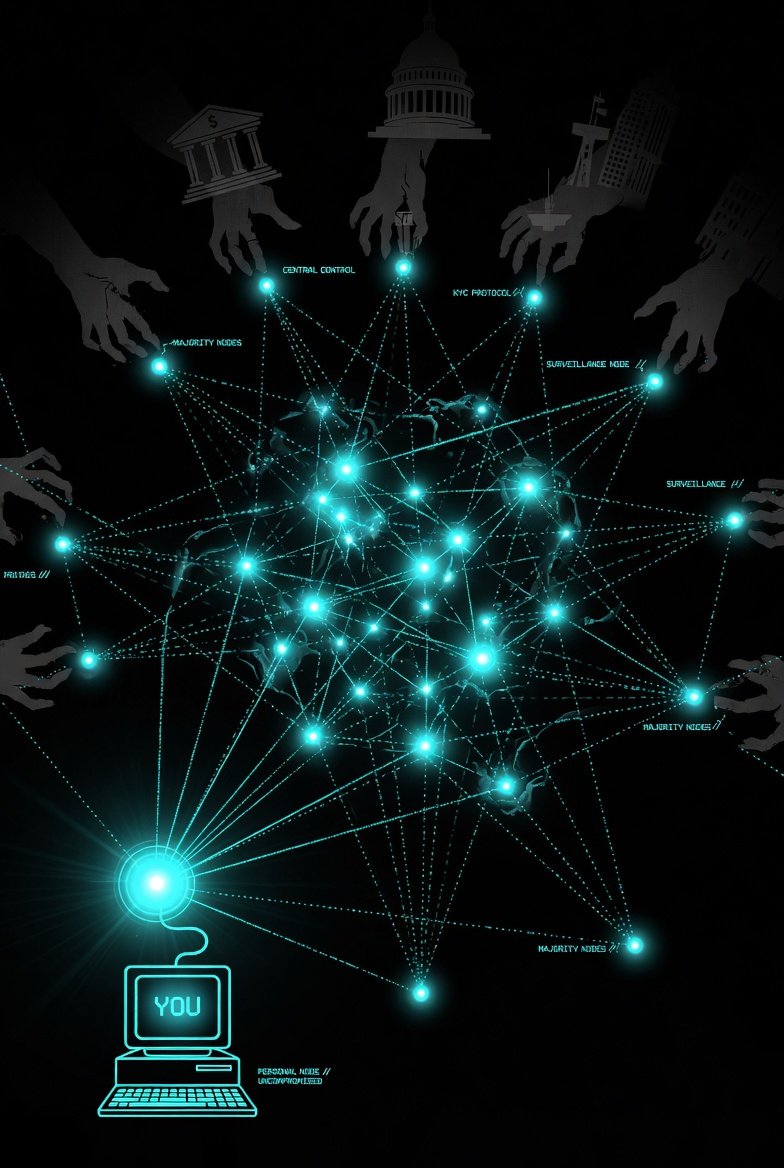
Nodes of Resistance: Why Running Your Own Hardware is the Ultimate Flex
You validate. You own.
Everyone uses Bitcoin. Billions of transactions. But how many people actually verify Bitcoin?
Most people don’t. They trust their phone wallet to tell them the truth. They trust an exchange to hold
their Bitcoin. They trust the network without understanding it.
Running a Bitcoin node is different. It’s checking the system yourself.
A Bitcoin node is a computer running Bitcoin software. It downloads the entire blockchain — the com‐
plete record of every Bitcoin transaction that ever happened. It validates every transaction. It verifies
every rule.
When you run a node, you’re not trusting anyone. You’re verifying.
Here’s what a node does:
- Downloads all Bitcoin transaction history (~500GB currently)
- Validates every transaction according to Bitcoin’s rules
- Verifies every miner’s work
- Checks that no rule violations occurred
- Broadcasts the current state to other nodes
A node doesn’t mine. It just validates. It’s the referee in the game. The referee doesn’t play, but
without the referee, anyone could cheat.
Why this matters:
Bitcoin’s security depends on distributed validation. If only five companies ran nodes, those five com‐
panies could control Bitcoin. They could change the rules. They could censor transactions.
But thousands of people run nodes. Miners, businesses, enthusiasts, idealists. If you want to change
Bitcoin’s rules, you have to convince thousands of distributed operators to upgrade.
That’s practically impossible. So Bitcoin’s rules stay stable.
Running your own node means: you don’t trust anyone. You don’t need anyone’s permission to
participate. You validate the system for yourself.
The latchkey kid didn’t trust adults to tell him the truth. He verified things himself. If
someone said the house needed repairs, he didn’t call an adult — he looked and verified. If someone said it was too cold to go outside, he tried it himself.
Running a node is the same. You don’t trust the Fed. You don’t trust mining pools. You don’t trust
Coinbase or Kraken. You validate it yourself.
Setting up a node:
You need:
- A computer (old laptop works fine)
- An external hard drive (~1TB)
- An internet connection
- About 2-3 weeks for the node to sync (download and validate the blockchain)
After that, it runs 24/7. It takes maybe 1% of your computer’s resources when it’s syncing. After that,
it takes almost nothing.
Cost: Roughly $200-500 if you’re buying hardware. Electricity: About $15-20 per year.
Why would you do this?
- Security: You verify Bitcoin. You don’t trust anyone else’s claim that Bitcoin is working correctly.
- Privacy: If you’re running a node, your transactions don’t get broadcast to mining pools. You’re not revealing to the network that you own Bitcoin.
- Sovereignty: You’re participating in the network as an equal. You’re not dependent on anyone else’s infrastructure.
- Resilience: If all the major mining pools disappeared, Bitcoin would still work as long as there’s one node running somewhere. You become part of that resilience.
- Ideological: Running a node is saying “I don’t trust institutions, so I’m checking the system myself.” It’s the ultimate rejection of centralized trust.
The network effect:
The more nodes that run, the more secure Bitcoin is. The more distributed the validation, the harder it
is for anyone to attack or change the system.
When you run a node, you’re adding one more piece of resistance to the network. You’re one more
person the government would have to pressure to change the rules.
This is what Bitcoin critics miss: Bitcoin isn’t secure because miners are honest. Bitcoin is secure
because honesty is the only option that works.
If a miner tried to break the rules, every node would reject their blocks. The miner would be wasting
electricity. All the incentives are aligned toward honesty.
Running a node reinforces that alignment. You’re saying: I’m checking. I’m verifying. You don’t get to
fool me.
The final flex:
Running a node is a statement. It’s saying: “I’m not dependent on your infrastructure. I’m not asking
for your permission. I’m validating the system myself.”
In a world of centralized services that spy on you, that freeze accounts, that charge fees, that change
terms — running your own node is a quiet rebellion.
It costs nothing. It takes barely any resources. It makes you literally a part of Bitcoin’s resistance to
centralization.