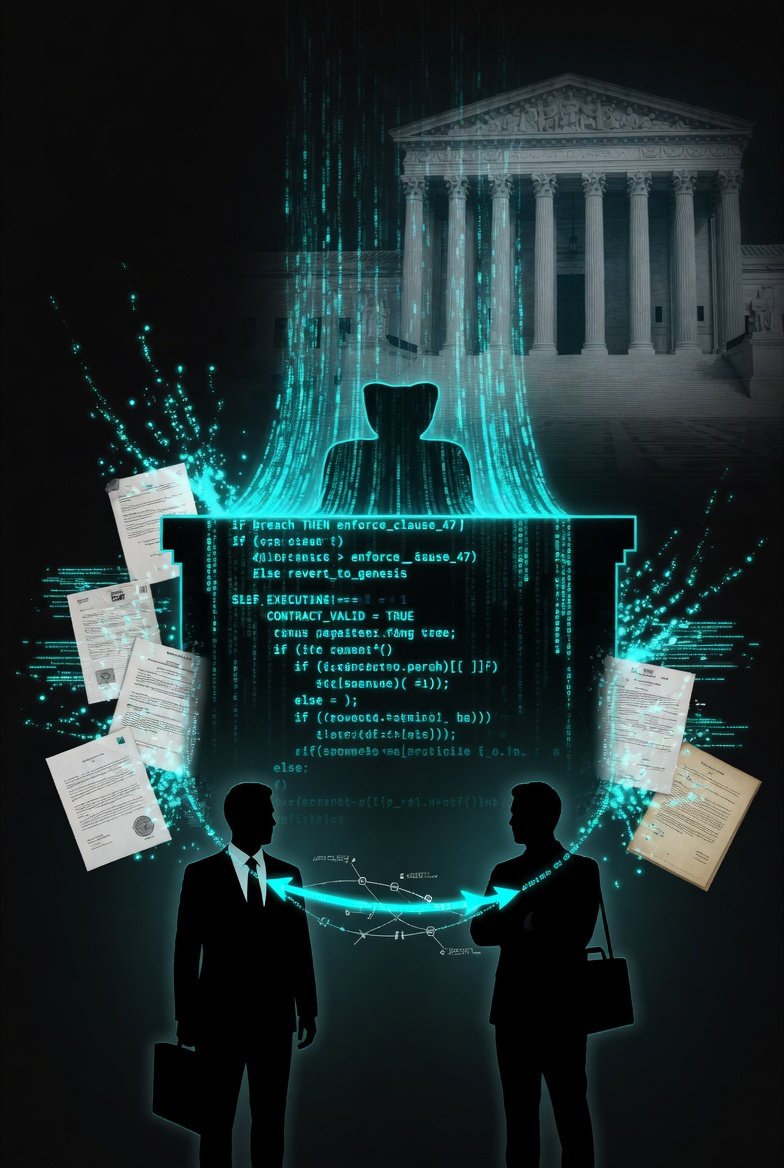
Smart Contracts (The Noir Edition): When the Code is the Law
No lawyers. No judges. No betrayal. Just math.
A contract is a promise. “I will pay you $1,000 if you deliver the goods.” “You will inherit the house
when I die, but you have to maintain it.”
Contracts are enforced by courts. You sign. You fulfill your obligation. The other party fulfills theirs. If
someone breaks the deal, you sue. You spend tens of thousands on lawyers. You wait years for a
ruling. The system is supposed to enforce the contract.
The system fails constantly.
Smart contracts are different. They’re automated agreements written in code. The code enforces the
agreement.
Here’s a simple example:
You and your friend make a bet. “If it snows tomorrow, you give me $100. If it doesn’t, I give you
$100.”
In the old system: You shake hands. Tomorrow you check the weather. One of you doesn’t pay (or
claims they didn’t agree). You fight. One of you has to sue to enforce the bet.
With a smart contract: You both send $100 into the contract. The contract has a rule: “If it snows, give
both dollars to [your friend].” The weather data comes from an oracle (a trusted data source). The
contract checks the weather automatically. At midnight, if it snowed, the contract sends $200 to your
friend’s Bitcoin address. The bet is settled. No dispute. No lawsuit. Math.
Why this matters:
Smart contracts remove the human element from agreements. No judge to bribe. No lawyer to argue.
No interpretation of “what the contract really meant.” Just code.
The code does what it says. Period.
This is revolutionary for international business. When you buy something from someone in another
country, you have to trust them. If they scam you, you have no recourse. You can’t sue in their
country. You can’t enforce a contract across international borders easily
With smart contracts, you both deposit the money in the contract. The seller delivers the goods. When
you confirm receipt, the contract automatically transfers the money to the seller. If you don’t confirm,
the contract automatically refunds you.
No trust required. Just code.
The limitations:
Smart contracts can’t verify the real world by themselves. They can’t check “did the goods actually
arrive?” They can only check data that’s fed to them by oracles.
An oracle is a service that provides real-world data to the blockchain. Weather data, price data, ship‐
ping confirmation data. The oracle is a potential weak point. If the oracle lies, the smart contract acts
on false data.
This is the “oracle problem.” For smart contracts to work perfectly, you need perfect data sources.
Those sources are often centralized (a weather service, a stock exchange).
Bitcoin doesn’t have smart contracts in the traditional sense. Bitcoin is Turing-incomplete — it can’t
execute arbitrary code. It can handle basic conditional logic (if-then statements) but not complex pro‐
grams.
Ethereum has full smart contracts. Ethereum is Turing-complete. You can write any program you want.
You can create complex agreements.
The tradeoff: Ethereum is more flexible but less secure. Bitcoin is simpler but stronger.
Smart contracts in the latchkey context:
The latchkey kid didn’t sign contracts. He operated on simple rules. “You eat the food, you clean the
plate. You use the toilet, you flush. You break something, you replace it.”
Those rules were enforced by consequence, not by police. You break the rule, you face the result.
Smart contracts are automated consequences. You agree to the rule. The code enforces it. No human
can change it.
Compare that to traditional contracts. You sign. A lawyer argues over interpretation. A judge makes a
ruling. The ruling is enforced by police. If someone has more money or better connections, they win
even if they’re wrong.
Smart contracts remove that arbitration. The code is the judge.
How this destroys corruption:
In traditional systems, power flows through people. You want a favorable ruling? You bribe the judge.
You want special treatment? You hire an expensive lawyer. You want to escape a contract? You take it
to a court where your friends are judges.
Smart contracts remove the person. The code is the judge. You can’t bribe the code. You can’t hire a
lawyer to argue with the code. The code does what it says.
This is why governments hate smart contracts. Governments depend on having discretion. They want
the ability to decide outcomes based on power and connections. Smart contracts remove that discre‐
tion.
A smart contract doesn’t care if you’re the government. It doesn’t care if you’re a billionaire. It
executes based on the rules, period.
The future:
Smart contracts are going to replace courts for routine agreements. Business contracts, insurance
claims, financial services — anything where the rules are clear and deterministic.
This will put lawyers and judges out of business. Not because they’re bad at their jobs, but because
the jobs themselves become unnecessary.
A contract that says “if A happens, pay B” doesn’t need human interpretation. It just needs code.
Corrupt courts will become irrelevant. If you can use a smart contract, you don’t need the court. You
can enforce the agreement directly through code.
This is why Bitcoin and Ethereum are existential threats to the existing power structure. Not because
they’ll make you rich. Because they’ll remove the human intermediaries that power depends on.
The latchkey kid never waited for adults to solve his problems. He coded solutions (metaphorically).
Smart contracts are the literal version: encoding solutions so they execute automatically, without
needing anyone’s permission or good faith.