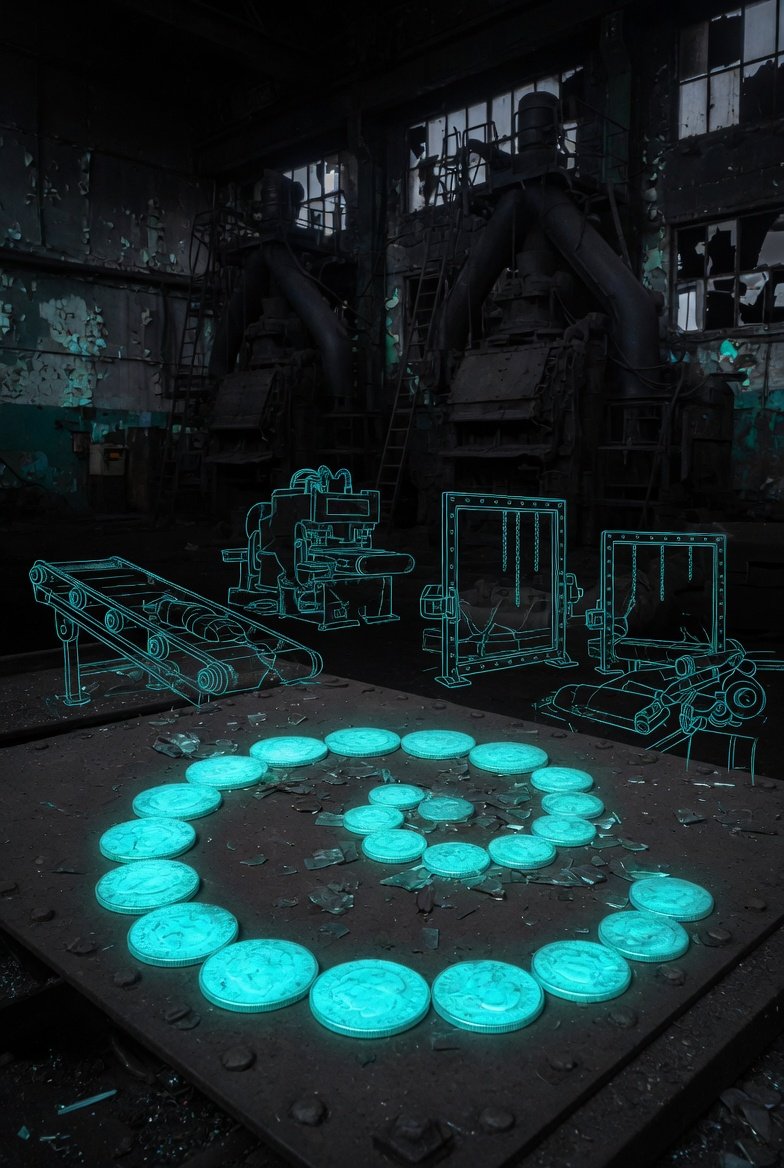
Steel Mill Scarcity: Understanding the 21 Million Cap
Some things are finite. That matters.
Dad worked the mill. Forty years at the same furnace. The contract said the pension was locked in.
The payout was guaranteed. It was written down. Both sides signed.
Then the company filed bankruptcy. The pension fund evaporated. Suddenly the guarantee meant
nothing. The contract that was supposed to be iron turned to smoke.
That’s what happens when the thing you’re holding — your pension, your currency, your savings —
can be diluted, printed, or erased by a centralized entity with more power than you.
Bitcoin has a different deal. Twenty-one million coins. That’s the hard cap. Not a suggestion. Not a
target. Not something the “Federal Reserve of Bitcoin” can adjust when times get tough.
It’s math. Embedded in the code. Auditable. Verifiable. Unchangeable.
Why does this matter?
Because scarcity is the only honest thing in economics.
A steel mill in 1980s Ohio was scarce. Skilled workers were scarce. Those jobs paid because they were
rare and they took years to master. When the mills closed, there was nothing to replace the scarcity.
New jobs paid less because they were abundant. Supply and demand. Simple.
Your dollar used to be scarce. It was backed by gold. There was only so much gold. That forced
discipline on the government. They couldn’t just print money to solve every problem.
Then 1971. Nixon ended the gold standard. The dollar became “fiat” — backed by nothing but the gov‐
ernment’s promise. And once it was only backed by a promise, they printed. And printed. And printed.
Your purchasing power in 1971? One hundred cents. Your purchasing power today in that same dollar?
About eight cents. That’s not economy, that’s theft with a bureaucrat’s signature.
Bitcoin can’t do that. The 21 million cap is written in stone. Not iron. Stone. Code that can’t be
changed without the majority of the network agreeing — and if they don’t agree, the network splits
and you keep your coins on the original chain.
That’s the firewall.
Every Bitcoin ever mined comes from solving a mathematical puzzle. No shortcuts. No printing. Every
puzzle solved costs real-world energy. You can’t fake it. You can’t print your way out of it. You have to
do the work.
Miners compete to solve puzzles first. The winner gets newly minted Bitcoin plus transaction fees. This
continues until the 21 millionth Bitcoin is mined — estimated around the year 2140. Then the incent‐
ive flips. Miners survive on transaction fees alone. The supply stops. Finite. Done.
That scarcity is the anchor. It’s what keeps inflation at zero. It’s what makes Bitcoin the hardest money
ever invented.
The politicians will tell you scarcity is bad. “It causes hoarding. It prevents economic growth.” They’re
lying. Scarcity is what preserves value. A finite supply means tomorrow’s Bitcoin is worth at least as
much as today’s. That’s discipline. That’s honest accounting.
The latchkey kid understood scarcity early. You’ve got thirty bucks to last the week until the next
paycheck. You spend it on what matters. No waste. No shortcuts. You make the math work or you go
hungry. That discipline is scarcity talking.
Bitcoin enforces that discipline at the network level. You can’t print your way out of problems. You
can’t bail out your mistakes. You have to solve them.
That’s not a bug. That’s the feature.