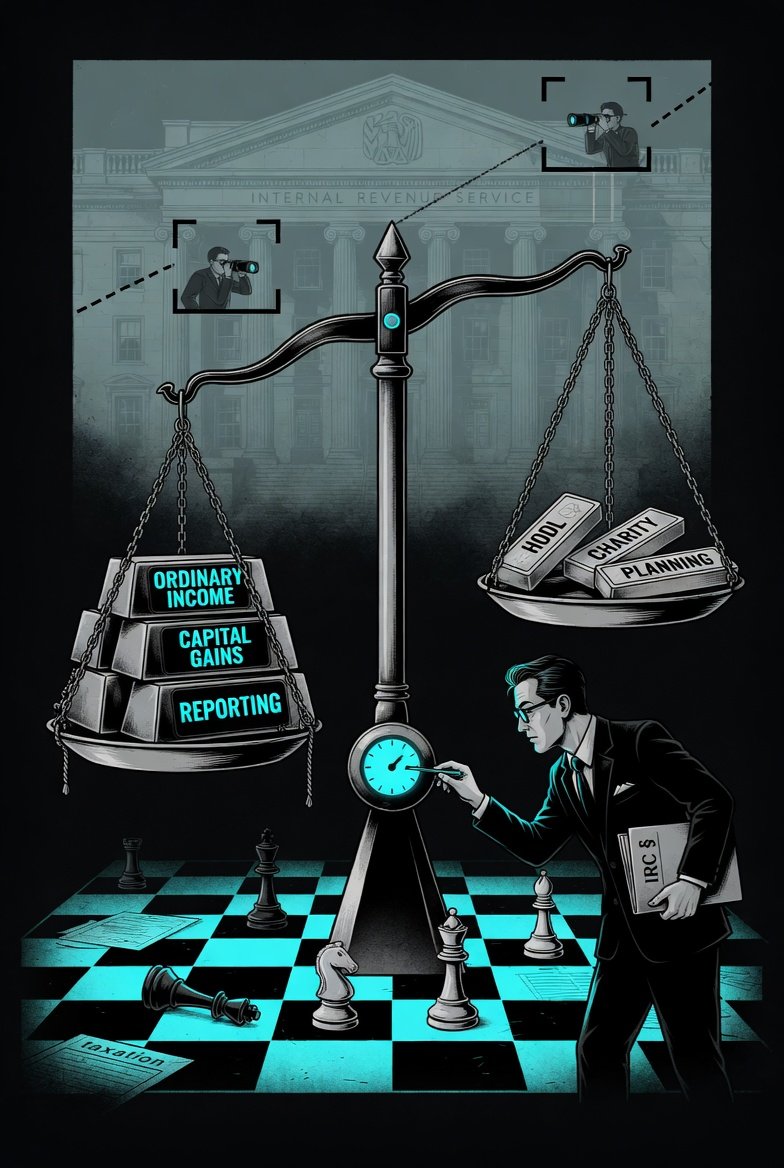
Taxation & Sovereignty: Playing the Game Without Losing the Harvest
Don’t hide. Understand the rules. Keep what’s yours.
This isn’t about tax evasion. This is about tax planning.
Tax evasion is illegal. You hide income, you get caught, you go to prison. Don’t do that.
Tax planning is legal. You understand the rules. You structure your life to minimize taxes within the law.
Everyone does this. Rich people do it better because they hire accountants.
Bitcoin creates new opportunities for tax planning that weren’t available before.
How Bitcoin is taxed:
In the US (and most countries), cryptocurrency is taxed as property, not currency.
When you buy Bitcoin for $30,000 and it rises to $60,000, you have a $30,000 capital gain. If you hold
it for more than a year, it’s long-term capital gains (taxed at 15-20%). If you sell it in less than a year,
it’s short-term capital gains (taxed as ordinary income, up to 37%).
When you spend Bitcoin on something, it’s a taxable event. If you bought Bitcoin at $30,000 and
spend it when it’s worth $40,000, you owe taxes on the $10,000 gain.
Mining Bitcoin is taxed as ordinary income. If you mine 1 Bitcoin worth $40,000, you owe income tax
on $40,000 even if you don’t sell it.
Staking rewards are taxed as ordinary income when received.
This is aggressive taxation. It basically treats any gain as income. Most countries have similar rules.
The tax planning opportunity:
1 . Hold long-term:
If you buy Bitcoin and hold it for over a year before selling, you get long-term capital gains rates
(15-20%). If you sell within a year, you get your ordinary income rate (up to 37%).
This isn’t sophisticated. It’s just planning to hold.
2 . Donate to charity:
If you have Bitcoin with large gains, donate it to a qualified charity. You get a deduction for the full
current value. You avoid the capital gains tax on the appreciation.
This is completely legal and quite tax-efficient.
3 . Tax-loss harvesting:
If you have Bitcoin with losses, sell it to realize the loss. This offsets other gains. Buy it back after 30
days (note: crypto tax laws are unclear on wash sales, so consult a professional).
4 . Opportunity zones:
If you’re in a jurisdiction with opportunity zone investments, you can structure Bitcoin investments to
get preferential treatment.
5 . Jurisdiction arbitrage:
If you’re a US citizen, you’re taxed on worldwide income. But if you’re a digital nomad living abroad,
there are strategies to minimize taxes.
Some countries (like El Salvador) are offering tax benefits for crypto adoption. Other countries (like
Portugal) have favorable capital gains rates for crypto.
This is legitimate tax planning, not evasion.
The sovereignty angle:
The latchkey kid understood the difference between playing by the rules and getting screwed by the
system.
He didn’t break the law. He understood it. He used it to his advantage.
With Bitcoin, you have new options:
You can hold wealth that’s hard to tax.
A government can’t easily tax Bitcoin they don’t know about. If you hold Bitcoin in cold storage with a
paper backup, the government has no way to know you own it.
This is different from cash (they can physically search you) or bank accounts (banks report to the gov‐
ernment).
Bitcoin gives you the option of financial privacy. That’s not tax evasion. That’s sovereignty.
You can move wealth across borders without permission.
If you’re living under a restrictive regime, you can move your wealth by moving Bitcoin. The
government can’t freeze it. Can’t seize it. Can’t prevent the transfer.
This is why Bitcoin matters to activists in Hong Kong, Venezuela, Iran, and other countries with capital
controls.
For people in the West, this is theoretically useful. Practically, you’re probably not going to emigrate.
You can plan your taxes legally.
By understanding Bitcoin’s taxation rules, you can structure your purchases, holdings, and sales to
minimize taxes.
This is completely legal. This is what wealthy people do with traditional investments.
The future of Bitcoin taxation:
Governments are developing better tracking. The IRS wants to track all crypto transactions. They’re
pushing for “travel rules” where exchanges must report transfers.
The EU has passed regulations requiring full transparency.
Over time, the privacy aspect of Bitcoin will decrease as surveillance increases.
For now, Bitcoin offers opportunities for legal tax planning that fiat doesn’t.
Understand the rules. Use them. Don’t hide — that’s illegal. Plan strategically — that’s legal.