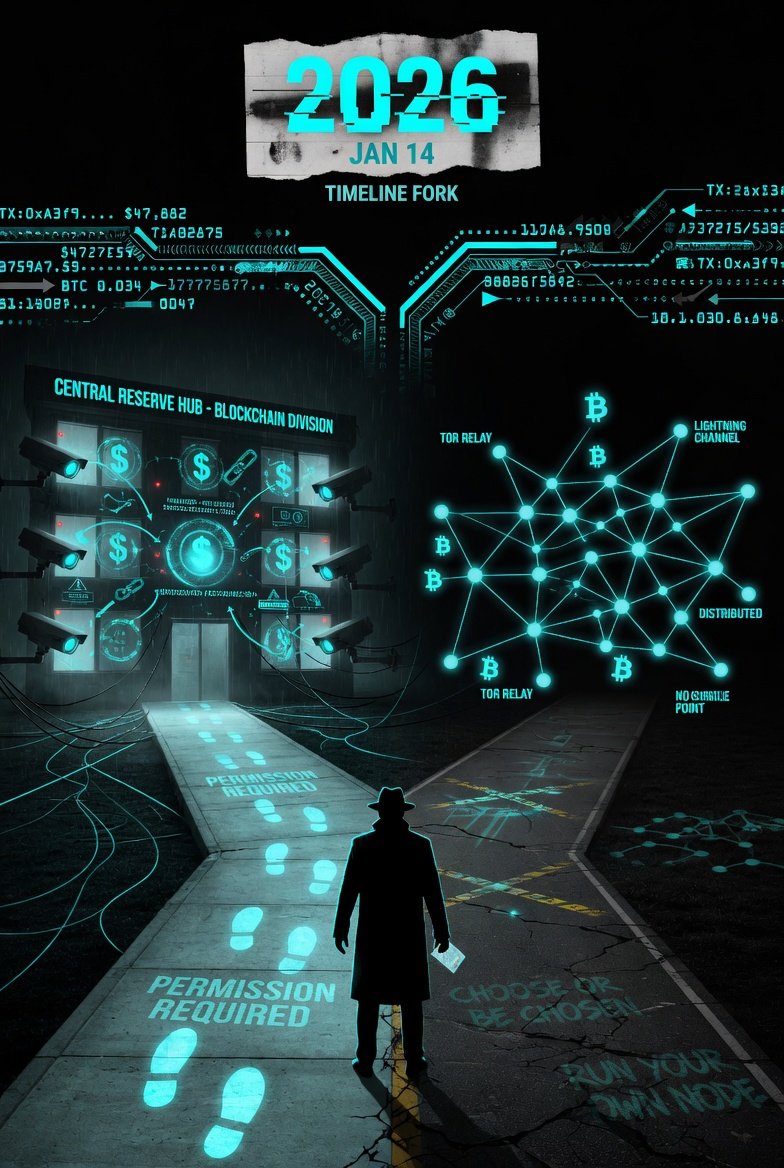
The 2026 Horizon: Where the System is Heading and How to Stay Ahead
The future is coming. Prepare or get left behind.
In 2026, several things are converging simultaneously
The Federal Reserve is moving toward a central bank digital currency (CBDC). The EU has launched
the digital euro. China already has its digital yuan. The US will have the digital dollar soon.
These aren’t cryptocurrencies. They’re programmable fiat. Controlled by governments. Traceable. Re‐
versible. Designed to replace cash and give governments complete visibility into every transaction.
Simultaneously, governments are cracking down on crypto. The SEC is regulating exchanges. The EU
is banning certain stablecoins. The IRS is demanding transaction reporting.
Bitcoin is the system that exists outside this framework.
What’s coming:
Central Bank Digital Currencies (CBDCs):
Every developed nation is launching a CBDC. The money is digital, but the government controls it.
This means:
- Complete surveillance of all transactions
- Programmable money (expires, restricted vendors, etc.)
- The ability to freeze your account without a court order
- Negative interest rates (the government charges you to hold money)
- Expiration dates on currency (you must spend it by a certain date or lose it)
This sounds dystopian. It’s not hypothetical. The EU is already testing programmable euros with
expiration dates.
Financial repression:
Governments are desperate. Debt is at record levels. They can’t raise taxes without causing riots.
They can’t default (that would destroy confidence). So they’ll use financial repression.
Financial repression means:
- Holding savers captive (you can’t move money internationally)
- Negative interest rates (you lose money by saving)
- Inflation (reduces the real value of debt)
- Confiscation (direct seizure of assets)
Every dollar in a bank account is vulnerable to this.
The talent exodus:
Talented people are leaving. They’re moving to countries with stronger currencies, better
governments, lower taxes.
This isn’t dramatic. It’s practical. If you can work remotely in Bitcoin, why stay in a country with
financial repression?
How to prepare:
1 . Diversify away from fiat.
Hold some portion of your wealth in Bitcoin. Not to get rich (Bitcoin might crash). But to preserve
wealth against fiat debasement.
Bitcoin is insurance. You hope you never need it. But if the government does confiscate bank accounts
or impose negative rates, Bitcoin is your escape hatch.
2 . Learn about Bitcoin now.
Before CBDCs launch, you’ll want to understand how to move value outside the government system.
Bitcoin is the primary option. Learning now, while there’s time, is critical.
3 . Establish privacy.
If you can, establish residency in a country with better financial privacy. Or use tools (like running a
Bitcoin node) to maintain privacy in your current location.
4 . Prepare for capital controls.
If the government does impose capital controls (you can’t move money internationally), Bitcoin is the
way around them.
This isn’t illegal (yet). But keep it in mind.
5 . Understand alternatives.
Some people will move wealth into real estate, precious metals, or other non-digital assets.
Understand the tradeoffs.
The timeline:
2026 is significant because:
- CBDCs are fully launched in major economies
- The initial wave of crypto regulation is settled (we know which projects survive)
- The ideological battle between CBDCs and decentralized crypto is clear
- Bitcoin has had another halving (supply continues to tighten)
- Institutional adoption of Bitcoin is mainstream
This is the inflection point. The bifurcation of the system is clear. You’re either in the programmablemoney system or the Bitcoin system. Both will coexist, but the choice you make now determines your
future.
The latchkey generation’s advantage:
The latchkey generation understands autonomy. They understand that nobody’s coming to save them.
They understand that you have to figure things out yourself.
That mindset is the latchkey generation’s advantage in the 2026 horizon.
While others are waiting for a government solution or a corporate product, the latchkey generation will
be running nodes, holding Bitcoin, and building alternatives.
This is an opportunity. It’s not a get-rich-quick scheme. It’s a generational shift in how value is stored
and transferred.
Those who understand it early will have an advantage.