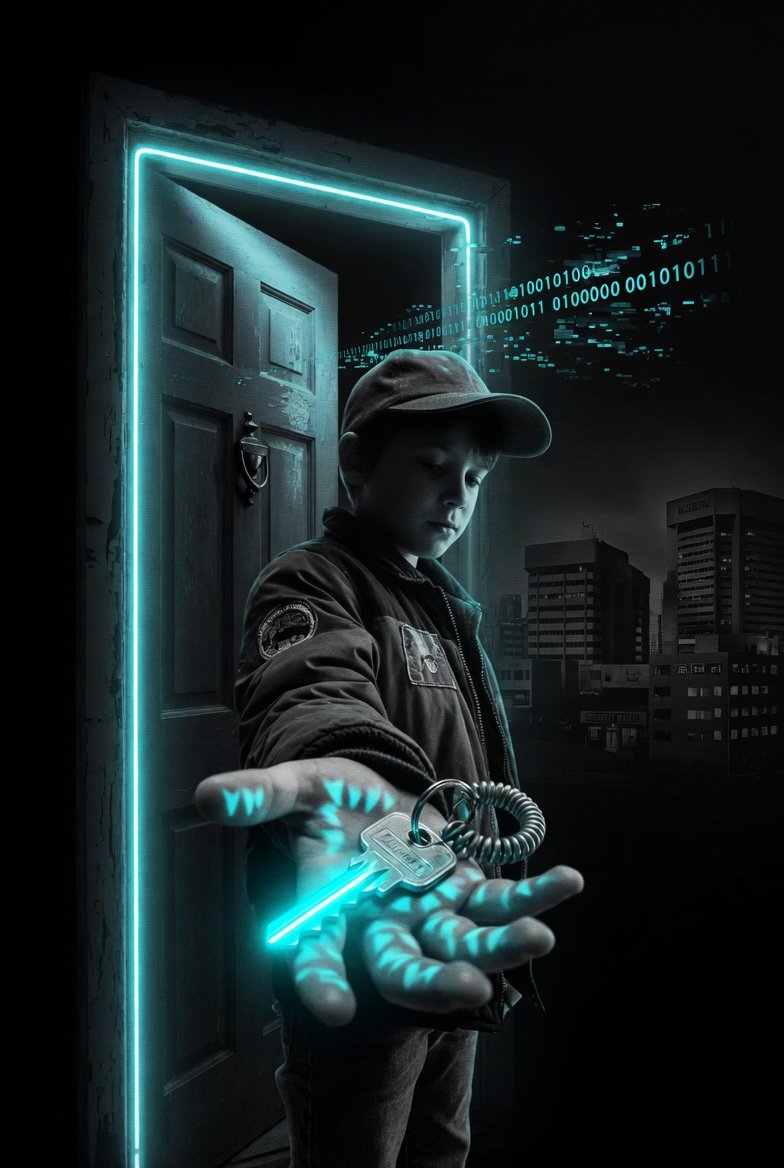
The Latchkey Protocol: Why Bitcoin is Your First Digital Key
Control. Not permission.
You get home from school. The house is empty. You pull a key from a string around your neck, unlock
the door, and walk in without asking anyone for permission.
That key is freedom. It’s also responsibility. It’s yours. Not your parents’. Not the bank’s. Not some
institution that owns the house and lets you borrow the entrance.
Bitcoin is that key for your money
For decades, we’ve been trained to hand our keys to a bank. Check your balance on their app. Move
money through their system. Get “approved” for a loan. The bank doesn’t own the money — they own
the access. They control the lock. You’re just the tenant in a house you think you own.
Then 2008 happened. The banks that should’ve collapsed got bailed out. The people who lost
everything got a helpline. That’s when millions of us realized: we’ve never had the key at all.
Bitcoin changes that. Not because it makes you rich. Not because you’ll get rich faster with crypto
than with a day job. Bitcoin changes everything because it puts the key back in your hand.
Here’s what that actually means:
You own the key. The key owns the door. The door opens without permission.
A Bitcoin address isn’t a bank account. It’s a lock and key system where you control both sides. Your
private key is the key on the string around your neck. Nobody else has it. Not Coinbase. Not your ex‐
change. Not the government. You lose it, the Bitcoin is gone forever. You keep it safe, your Bitcoin is
yours forever.
That’s not hyperbole. That’s the architecture.
No bank can freeze it. No government can seize it. No politician can print more of it. Twenty-one mil‐
lion Bitcoin exist. That’s it. No more can ever be created. That’s the hard cap — the steel wall against
inflation, manipulation, and theft dressed up as “monetary policy.”
The latchkey kid didn’t wait for permission to make dinner. Didn’t ask the bank’s approval to feed
himself. He used the key, turned the lock, and took care of what mattered.
Bitcoin lets you do the same with your money.
You don’t need a bank’s permission to send Bitcoin. You don’t need their approval to withdraw it. You
don’t need their system to move. You need your key and the network. That’s it. The network doesn’t
ask questions. The network doesn’t freeze accounts. The network doesn’t care if you’re twenty-five or
seventy-five, broke or loaded, politically aligned or not.
It’s fair because it’s stupid. It has no emotion. No discretion. No corruption.
For a generation that grew up learning that institutions lie, that pensions vanish, that recovery never
comes — that’s everything.
The Latchkey Protocol isn’t a new invention. It’s the oldest idea in the world: own your own key, open
your own door, keep what’s yours. Bitcoin just made it possible at scale, across borders, without
asking for permission.
That’s the point. That’s always been the point.